.svg)
NIST leans towards governance and accountability.
The EU towards human oversight.
The Vatican calls for use that serves human dignity, with equity, under a shared morality.
All three share the same premise — that human impact must be weighed — but the Vatican is the most explicit about what that means and why: it warns that AI has no conscience, no human connection, and no real sense of good or bad, so humans must supply what it cannot, through the system or its controls.
There are other considerations related to AI in general such as environmental impacts, concerns over cognitive decline, impact on employment, concentration of power, dependence, and unhealthy interactions with AI. Those shouldn’t be ignored but are outside the scope of this article which focuses on appropriate use, correctness, and accountability.
Correctness and accountability are where many conversations stop.
Correctness: did the model provide a valid response and did the agent take the right actions?
Accountability: who answers for it if it is wrong?
Both matter — and accountability, at least, is on familiar ground.
It sits where it always has, higher in the organization than where the work occurs, judged on whether reasonable controls were in place to prevent, detect, and correct errors. A new wrinkle is how courts and stakeholders will view agent or AI errors vs those of humans. That remains to be seen putting even more emphasis on the control environment.
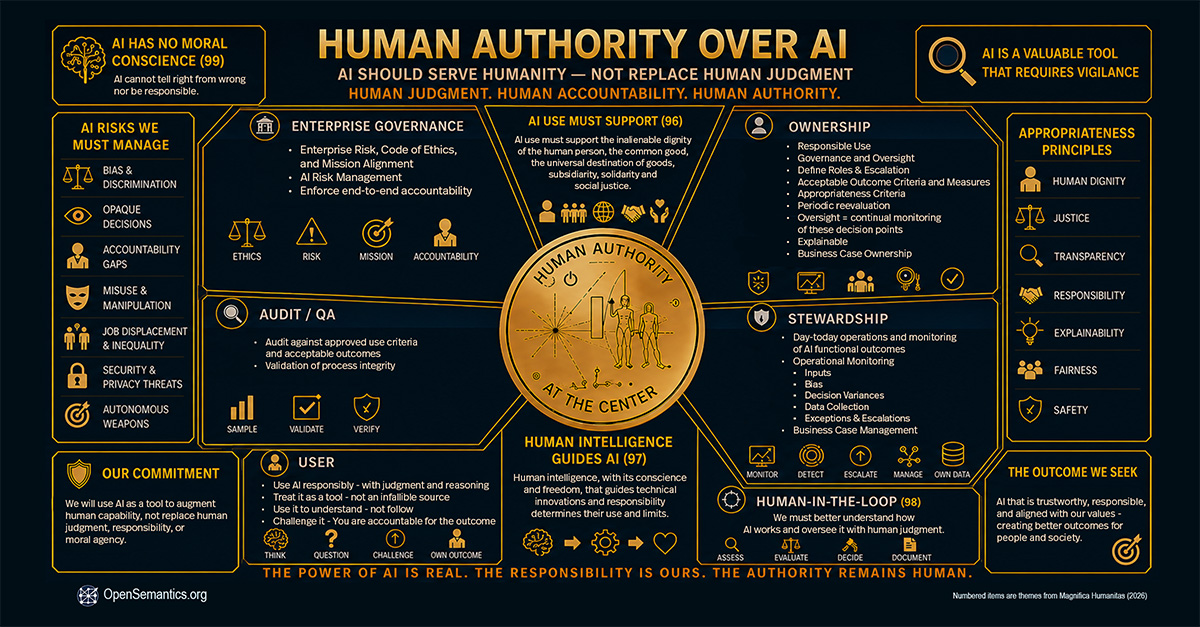
What's genuinely new is a third question –under what circumstances is the use of AI and agents appropriate in the context of Human Authority Over AI? Responsible AI frameworks from NIST, the EU, and others touch on this but not to the degree of the Vatican’s writings.
Most AI uses are operational, clearing the appropriateness question quickly. But that clearance must be an active affirmation, not an assumption left unexamined. The appropriateness test must be deliberate, in the same manner as risk management.
This is no different from hundreds of other decisions made in businesses every day.
Decisions are made as close to the work as possible under defined policies with upwards visibility. Appropriateness is a new question within a well-known construct.
Human Authority Over AI is more than correctness. It's a commitment that AI is applied thoughtfully and intentionally, with full regard for its impact on people.
Traditional controls were built for correctness and repeatability. Human Authority adds a lens of appropriateness they were never designed to carry. This requires new control objectives and mechanisms designed for that purpose.
Full breakdown and the framework diagram below.